

Is TeamLab Planets Worth Visiting? 10 Things to Know Before You Go
There’s never a shortage of things to do in Tokyo. If you love art, light, and immersive spaces, TeamLab is one of those names you’ve probably seen everywhere, and for good reason.
Since our years living in Japan, we’ve visited several TeamLabs, from the old one in Odaiba to the current ones at Azabudai Hills and Toyosu. Every visit still feels exciting. The scale, the sound, and the atmosphere always leave an impression.
If you’re planning your Japan trip and wondering whether TeamLab Planets in Tokyo is worth it, this guide has everything you need to know. From what makes it unique to the best time to visit, what to wear, and a full walkthrough of the exhibits, here’s what to expect before you go.
Plan your trip with our favorite resources
Where to Stay in Japan: check best deals
Transport & activities: klook.com (save up to 10% with code DANAYAO)
eSIM for Japan: stay connected with Airalo
What Is TeamLab in Japan
TeamLab is a Japanese art collective that creates large-scale interactive digital installations combining light, sound, and technology.
Think of it as an interactive art museum where instead of just looking at art, you touch it, feel it, and move through it. The experience pulls you completely into the space, and visiting one feels like walking inside a dream.
How Many TeamLabs Are There in Tokyo
There are currently 2 TeamLab exhibitions in Tokyo.
The first is TeamLab Borderless, located in Azabudai Hills. It is known for its interconnected digital spaces that continuously evolve. The artworks move across rooms and respond to movement, creating a feeling that there are no real boundaries between spaces, therefore the name Borderless.
The second is TeamLab Planets, located in Toyosu. This version is all about physical connection and sensory experience. You walk barefoot through shallow water, mirrored spaces, and soft floors while surrounded by moving light and sound.

TeamLab Planets vs Borderless: What’s the Difference
Both exhibits are immersive and visually stunning, but they do offer different experiences.
Borderless feels like a maze of infinite digital worlds that shift around you, each one blending seamlessly into the next.
Planets, on the other hand, is more physical and sensory. The focus is on interaction through touch, reflection, and movement. You will feel the textures under your feet, the water around your legs, and the rhythm of the music that fills each room.
What Makes TeamLab Planets Unique
What makes TeamLab Planets stand out are its water exhibits and barefoot experience.
Every step connects you physically to the art. You can feel the temperature and flow of the water, the texture of the floors, and the subtle vibration of sound as you move from one space to another.
The space is divided into two main areas. The indoor section has seven large-scale exhibits, while the outdoor garden features two installations surrounded by real plants and flowers.

Is TeamLab Planets Worth Visiting?
Short answer: yes, absolutely, especially if you’ve never been a TeamLab before.
TeamLab Planets is one of the most unique art experiences in Japan. The combination of calming music, reflective spaces, and water-filled rooms creates something that feels less like a museum visit and more like guided meditation with art.
That said, how much you enjoy it really depends on your comfort level.
What I mean by that is….you have to take your shoes off before entering, and several exhibits require you to walk through water that can reach up to your knees.
If the idea of stepping into water that other people have walked through makes you uneasy, this might not be for you. It’s the most discussed thing in the comment section of the video I published so I figured I would address it here too.
In that case, TeamLab Borderless is the better choice. It’s stunning, completely dry, and doesn’t involve any barefoot sections.
The entire visit takes about 2 hours, and while the venue itself isn’t huge, it’s packed with detail and cool and different things in each room.
In short, it’s a must-visit for first-timers and anyone who loves modern art, sensory experiences, or creative spaces, but won’t be a good fit for those who mind barefoot and stepping into water with others.

10 Things You Need to Know Before Visiting TeamLab Planets in Tokyo
1. It’s super popular, so book early
Tickets for TeamLab Planets sell out fast, especially during weekends and holidays. If you already know your travel dates, we recommend booking as soon as your date is available. We are talking about 1 month in advance, so that you can secure the exact time slot you have in mind.
If you are still planning, then reserve as soon as possible or at least a week in advance. You probably won’t be able to get the time slot you want, but at least secure the date to fit into your itinerary.
Morning slots tend to disappear first since that’s when the museum is less crowded. Mid-afternoon and evening tickets are easier to find but come with more people and longer lines.
How much do tickets cost?
Tickets cost around 4,400 yen for adults, and children’s tickets are usually about 2,000 yen cheaper. Prices can vary slightly depending on demand and time slot.
If you want to grab your tickets in advance, you can check the current availability here.
Tip: Use code DANAYAO at checkout to get up to 10% off!
2. Line up before your time slot
Even with a timed entry, the line gets long…really long.
When we went for the earliest time slot in the day, the line was already longer than half a mile on the street before the gates even opened.
It’s worth arriving at least 30 minutes early so you’re near the front of the queue and can enter right when your slot starts.
If you show up right at your scheduled time, you’ll likely still spend another 20 to 30 minutes waiting to get inside.
3. How much time do you need at TeamLab Planets
The entire experience takes about 2 hours, and you’ll want some additional cushion time for logistics like debriefing and putting shoes into the locker, though some people finish faster if they move quickly through the exhibits.
We recommend not going too fast and just taking your time. Each room is different, and the transitions are part of the experience.
You can also loop back to certain rooms if you want to see them again before you leave.
4. Best day to go to TeamLab Planets
Weekdays are always the best choice.
Crowds are lighter, and you’ll have more room to explore without waiting around. Avoid weekends and public holidays if you can…the difference in crowd levels is huge.
5. Best time of day to go
Morning is the best time to visit. The earliest slots are calmer, the water feels cleaner, and you’ll have more time to take everything in without being rushed.
When we went right at opening, there were maybe 5 people in the “Floating in the Falling Universe of Flowers” room. When we came back later, it was packed, with people laying all over the floor taking photos.
Late-night slots are also less crowded but you might feel a bit rushed toward closing time…or not too peaceful if you feel uneasy about the feet water from all day.

6. You’ll be barefoot the entire time
Before entering, you’ll store your shoes and personal items in a locker. You’ll get a small key that you keep with you throughout your visit. Everyone goes in barefoot because several exhibits have water, with some areas reaching up to your knees.
It’s all part of the experience: feeling the temperature and texture under your feet is what makes TeamLab Planets so unique.
That said, if you really don’t like the idea of walking barefoot where other people have stepped or don’t want to get wet at all, TeamLab Borderless is a much better fit. You keep your shoes on the whole time there.
7. Reflective floors and dress code
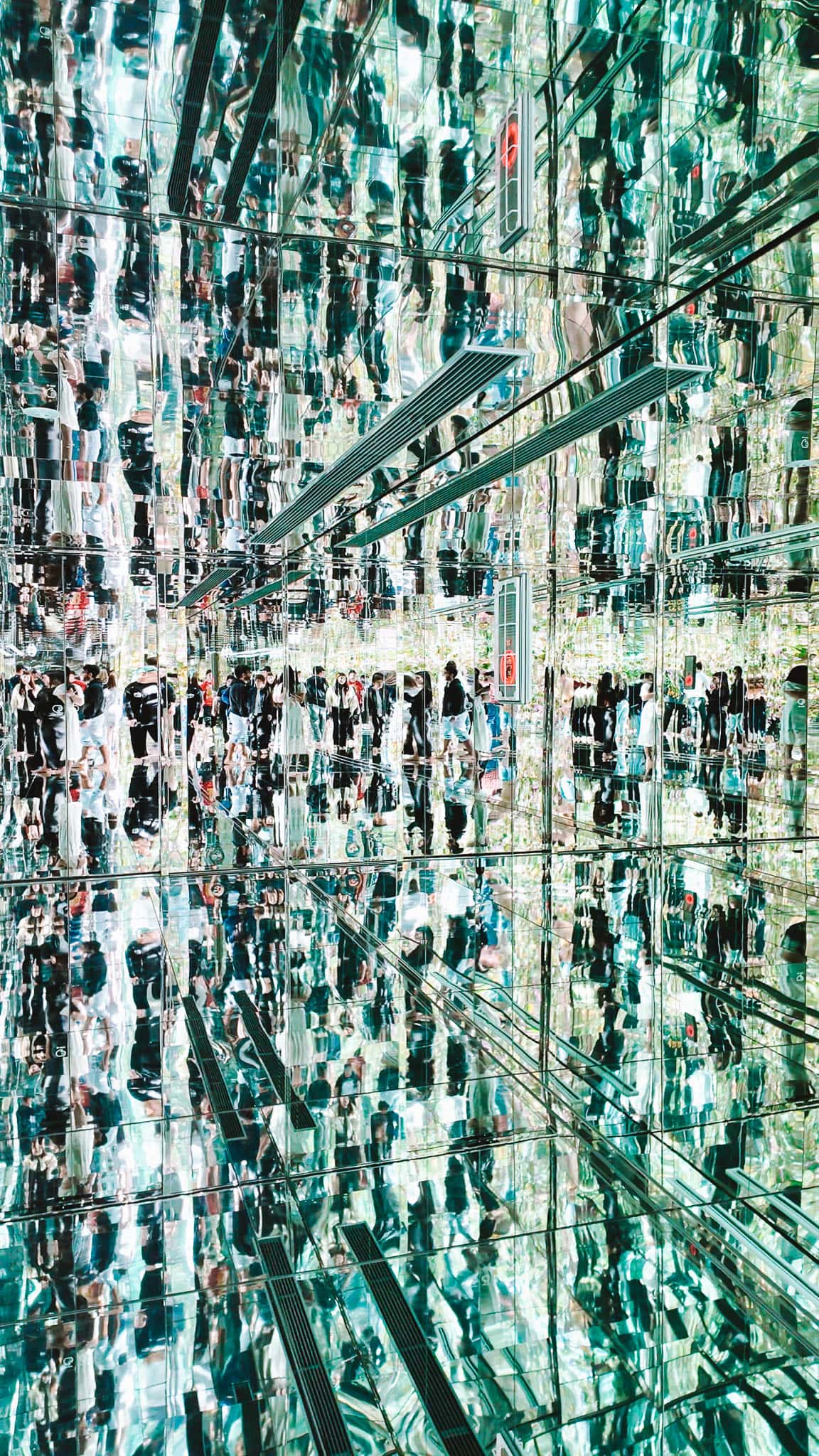
Many of the non-water exhibits have fully reflective floors and mirrored surfaces, which means what you wear actually matters.
If you plan to wear a skirt or dress, just know that the reflections might make you feel a little too visible from certain angles.
To help with that, the staff offers safety pants near the entrance. They’ll also mention this during the short pre-entry briefing.
If you’re wearing jeans or long pants, definitely take advantage of the rentals too. The water levels can reach up to your knees, and we’ve seen plenty of people leave with soaked pant legs from trying to roll them up.

8. Indoor and outdoor exhibits, you might get wet
Most of TeamLab Planets is indoors, but there are outdoor sections that can get a little messy if you’re not prepared.
The main water exhibits “Path of the River and the Waterfall” and “Drawing on the Water Surface: The Koi Pond” are where you’ll definitely get wet.
The river section has ankle-deep water that flows downhill, while the koi pond can reach up to your knees. If you’re visiting during cooler months, the temperature difference can be noticeable but still manageable.
There’s also a Moss Garden area where water drips from above as staff water the plants. It’s part of the experience but worth noting if you’re hoping to stay dry,
Bring or wear something that dries quickly, and you’ll be fine.

9. Lockers and restrooms available
Lockers are provided right before you enter the exhibit area.
They’re free to use and big enough to fit backpacks, shoes, and small shopping bags. You’ll get a waterproof key band to wear on your wrist so you can move through the exhibits hands-free.
Restrooms are located right next to the shoe locker area, not inside the exhibits. So it’s best to use the restroom before you go in.
There are also towel stations between some of the water exhibits, so if your legs get splashed, you can quickly dry off before moving on to the next room.

10. TeamLab Planets is temporary, here’s when it’s closing
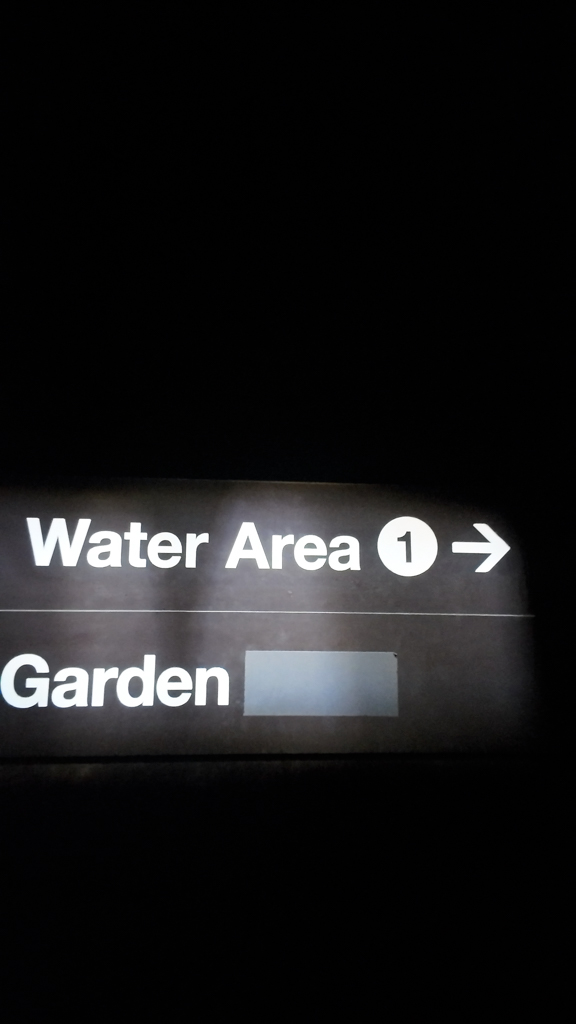
TeamLab Planets Tokyo isn’t a permanent exhibit.
It’s currently scheduled to close at the end of 2027, though its run has already been extended several times due to its popularity.
If you’re planning a trip to Japan in the next few years, don’t wait too long to add it to your itinerary. There’s always a chance it could wrap up earlier if the location changes or transitions into a new project.
If you’re traveling to Kyoto, a brand-new TeamLab Biovertex just opened there, so if your itinerary includes Kyoto, it’s definitely worth checking out.
What to Expect Inside TeamLab Planets
Before entering, you’ll get a short pre-entry briefing where staff explain the rules and what to expect. You’ll then remove your shoes and socks, store your belongings in a locker, and grab your key wristband.
Once inside, you’ll move through a set path that includes both indoor exhibits and a small outdoor garden area. There’s no time limit, so take your time and let yourself slow down, that’s part of the experience.
Here’s what you can expect in each room.
Path of the River and the Waterfall
The first part of TeamLab Planets sets the tone right away. You’ll walk up a slightly inclined path filled with shallow water that reaches your ankles. The surface glows with soft light, and at the end of the path, a digital waterfall cascades in front of you.
It’s a strange but beautiful feeling, walking through warm, flowing water in a dark room surrounded by sound and motion. The floor can get slippery, so take your time.
Towels are available in the next room if your pants or legs get a little wet. Once you’re dry, you’ll move straight into the next exhibit.
Soft Black Hole
This room feels like stepping onto a soft, uneven trampoline. The floor sinks slightly with every step, and it’s completely dark except for the faint light that guides your path. You’ll wobble, laugh a little, and probably lose your balance once or twice, and that’s the point.
The idea is to experience how your body adjusts when the ground isn’t stable. It’s playful but also oddly calming once you stop fighting it. If balancing becomes tricky, you can steady yourself by touching the walls.
For anyone who needs assistance, there’s a separate walkway that bypasses this room, but if you can, give it a try. It’s simple but surprisingly memorable.
Infinite Crystal Universe
This is the room most people think of when they picture TeamLab. You’ll step into a maze of hanging LED lights that shimmer and change color in perfect rhythm with the music. The reflections on the floor and walls make it feel like you’re floating in endless space.
The lights react to movement, so as people walk through, the colors and patterns shift around them. It’s easy to lose all sense of direction here, but that’s what makes it so magical.
This is also one of the most photogenic spots in TeamLab Planets, so expect people to pause for pictures. Take your time, look up, and let your eyes adjust, the longer you stay, the more detail you notice.

Drawing on the Water Surface: The Koi Pond
This is one of the most famous exhibits at TeamLab Planets, and it’s where you’ll understand why everyone talks about the water. As you walk down a sloped hallway, the floor gradually fills with warm water that reaches up to your knees.
Digital koi and flowers are projected onto the surface, swimming and blooming in response to your movement. When two koi cross paths, they burst into petals that drift across the water! It’s mesmerizing to watch up close.
It’s also one of the most peaceful rooms in the entire museum. The combination of soft music, reflections, and rippling water makes you forget there’s a crowd around you. Take your time here.
Expanding 3D Existence: Giant Bouncy Balls
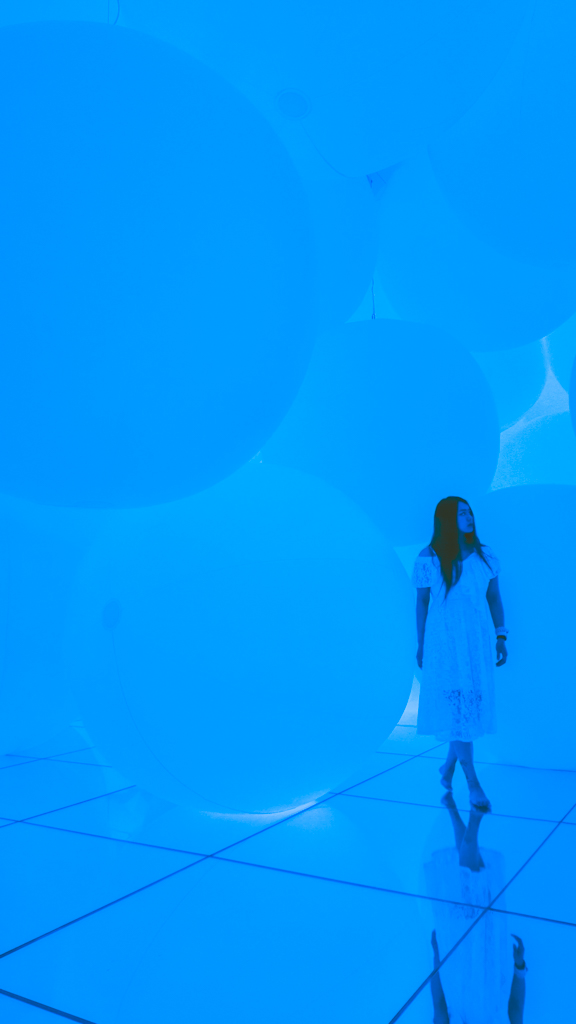
After the calm of the koi pond, this next room feels completely different. You’ll step into a space filled with giant glowing spheres. some floating, some rolling slowly across the floor. Each one changes color when touched, and when one moves, the rest respond in a chain of shifting light.
The room feels alive, especially when there are lots of people inside. The sounds, colors, and movement all blend together, creating a kind of playful chaos that still somehow feels relaxing.
It’s one of those moments that brings out your inner child. You’ll catch yourself reaching out to tap the lights just to see what happens next.
Floating in the Falling Universe of Flowers
This is one of the most beautiful and meditative exhibits inside TeamLab Planets. You’ll step into a large dome-shaped room surrounded by projections of flowers that grow, bloom, and wither in a continuous cycle. The visuals are synced with soft music, creating an atmosphere that feels both peaceful and hypnotic.
The flowers change with the seasons, so every visit looks slightly different. You can sit or lie down on the mirrored floor and watch the blossoms float above you. It’s almost impossible not to lose track of time.
When we went, it felt quiet and personal, like the room was breathing with you. Just be prepared: later in the day, it can get crowded, with people laying across the floor for photos. So, visiting early makes a big difference here.


Moss Garden
After the dark, glowing rooms inside, stepping into the Moss Garden feels like a breath of fresh air. This is one of the outdoor sections of TeamLab Planets, and it looks completely different depending on the weather and time of day.
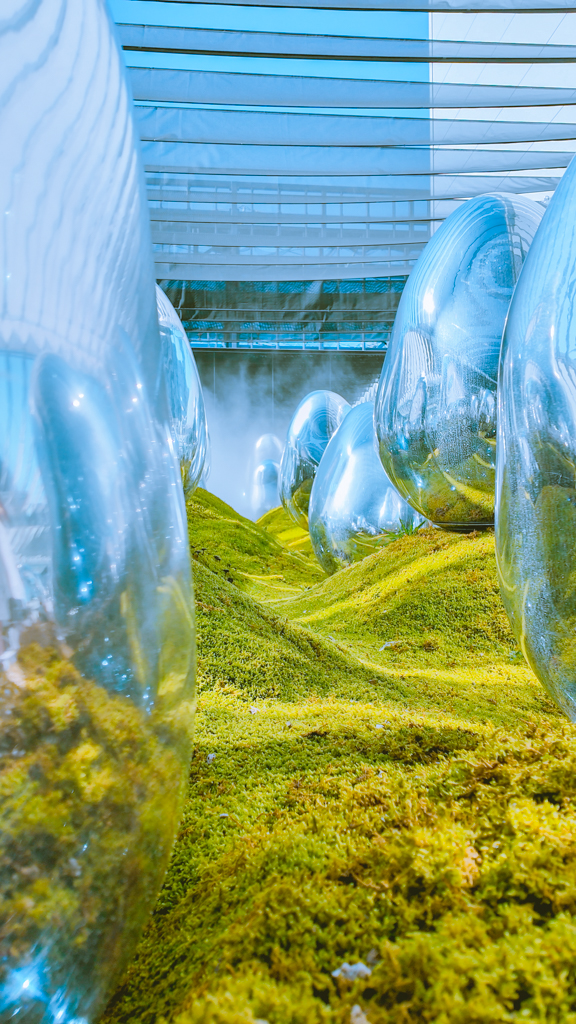
You’ll be given slippers before entering, and as you walk through the garden, you’ll see rows of silver, egg-shaped sculptures called ovoids. These ovoids react to their surroundings, shifting colors and emitting soft sounds when touched or when the wind moves them.
The moss and natural light make this area feel quieter and more grounded, a nice contrast to the sensory intensity inside. You might get a few drops of water from the plants above, but that’s part of the atmosphere here.

Floating Flower Garden
This is one of the final exhibits at TeamLab Planets, and it feels like stepping into a dream. You’ll walk into a space filled with real, living flowers suspended from the ceiling, gently moving up and down as people enter. The flowers part and close around you, creating the illusion that you’re floating inside a living garden.
It smells faintly floral and earthy, and the light constantly shifts, making the colors of the petals change as you move. You’re not allowed to touch the flowers, but you can stand quietly beneath them and feel the air move as they lift and lower.
Look up, take a deep breath, and enjoy the calm. It’s one of the most photogenic and peaceful endings to the entire TeamLab experience.
Athletics Forest (New in 2025)
In early 2025, TeamLab Planets introduced a brand-new area called the Athletics Forest, designed to bring even more movement and play into the experience. It’s a colorful, interactive zone filled with soft structures, glowing spheres, and responsive soundscapes that shift as people move.
Some sections are made specifically for kids under 12, like the Multi Jumping Universe, where they can bounce across soft platforms surrounded by lights that react to every step. There’s also Aerial Climbing and Balance Stepping Stones, which combine motion, light, and sound in a more physical way than the rest of the museum.
Even if you’re not part of the under-12 crowd, it’s still fun to explore and watch how the visuals respond to movement. It adds a playful, high-energy contrast to the calm, reflective exhibits that come before it.
Conclusion
TeamLab Planets Tokyo is one of those rare experiences that feels both futuristic and deeply human. You’re surrounded by technology, yet the entire space is designed to slow you down and make you more aware of your senses.
It’s fun, creative, and a little surreal. You’ll leave with wet feet, hundreds of photos, and the quiet sense that you just experienced something that can’t really be put into words.
If you love immersive art, design, or just want something that feels different from the usual sightseeing stops, TeamLab Planets is absolutely worth adding to your Tokyo Family-Friendly things to do list. And if you’d rather stay dry, TeamLab Borderless offers an equally beautiful experience without the water.
Either way, it’s one of those Japan experiences that stays with you long after you’ve left.
You must be logged in to post a comment.